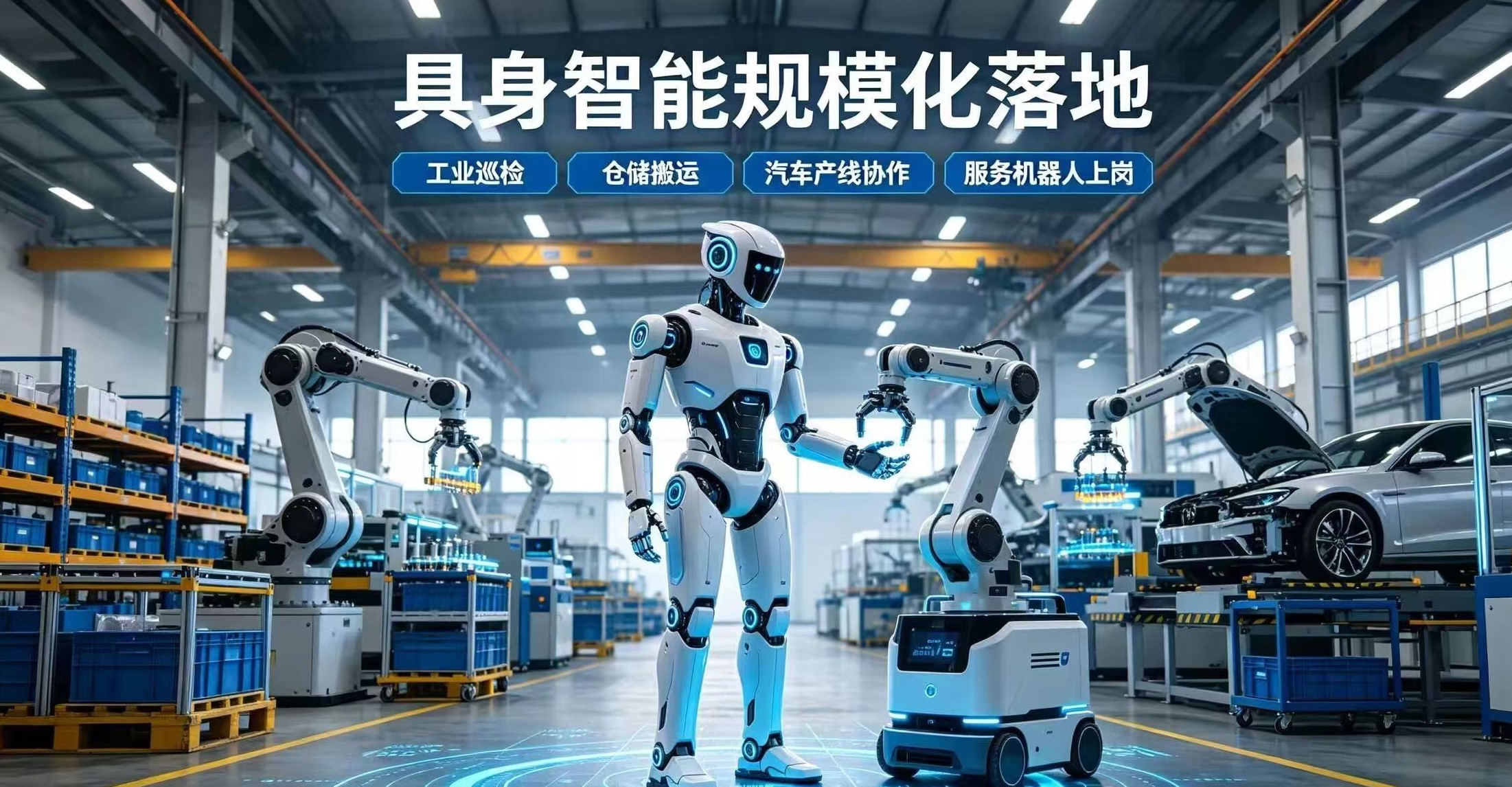
WAIC 2026 Observer: Embodied Intelligence Accelerates Transition from Technical Validation to Industrial Deployment

   From July 17 to 20, 2026, the World Artificial Intelligence Conference (WAIC) was held at the Shanghai World Expo Exhibition and Convention Center. As one of the most influential annual events in the global AI sector, this year's conference attracted participation from hundreds of enterprises and research institutions both domestically and internationally. Among all exhibition segments, embodied intelligent robots emerged as the most prominent focus of attention.

   Compared with previous editions, this year's exhibition sent a clear signal: embodied intelligence is accelerating its shift from technical demonstrations toward tangible industrial application scenarios.

I. Real-World Scenario Testing: From Exhibition Booths to Operational Environments

   This year's WAIC established a dedicated exhibition zone for embodied intelligence for the first time, featuring constructed test environments covering smart factories, smart retail, smart healthcare, and other scenarios. With over 300 actual robots on display, enterprises moved beyond mere dynamic showcases to bring real operational settings—including production lines, retail stores, and pharmacies—directly into the exhibition space.

   In the smart manufacturing zone, multiple enterprises deployed 1:1 replicated automobile assembly and logistics handling assembly lines. Humanoid robots collaborated with collaborative robotic arms to perform precision assembly, material loading and unloading, quality inspection, and other processes. In the service robotics section, food and beverage and retail robots with full-process autonomous operation capabilities achieved closed-loop execution from order recognition to final product delivery.

   Notably, the conference also partnered with relevant authorities to set up outdoor real-world testing areas, where some enterprises' humanoid robots participated in public service demonstrations including traffic guidance and patrol security. This indicates that embodied intelligence has preliminarily acquired the capability to execute tasks in unstructured environments.

II. Technological Frontlines: VLA Models and High-Precision Perception

   The industrialization of embodied intelligence is highly dependent on the synergistic evolution of both the "brain" and the "cerebellum."

   At the "brain" level, Vision-Language-Action (VLA) models have become the core R&D focus for leading enterprises. By integrating multimodal perception, natural language understanding, and motion planning into a unified framework, robots are now able to comprehend abstract instructions in complex scenarios and decompose them into autonomous execution sequences. Multiple enterprises demonstrated "one-brain-multiple-bodies" technical solutions, where a single model framework can drive terminal devices of different form factors, effectively reducing deployment costs.

   At the "cerebellum" level, high-precision force control and tactile perception have emerged as key differentiators in competitive positioning. At this year's exhibition, multiple domestic enterprises unveiled next-generation dexterous hands, featuring over 20 active degrees of freedom and fingertip-integrated multidimensional tactile sensors capable of real-time perception of material properties, hardness, and slip tendencies. Several solutions have already achieved commercial deployment in industrial scenarios such as consumer goods quality inspection and precision assembly.

   On the computing front, domestic high-performance edge computing platforms achieved milestone breakthroughs, with certain humanoid robot products now supporting over 700 TOPS of computing power and continuous 24/7 operation, providing a hardware foundation for large-scale deployment.

III. Industry Consensus and Challenges: The Data Gap Remains

   Despite rising industry momentum, stakeholders within the sector maintain a rational assessment of the current development stage. Experts at the conference pointed out that large-scale deployment of embodied intelligence still faces three major challenges:

First, a critical shortage of real-world data. Unlike large language models, which can leverage vast amounts of internet text data, embodied intelligence requires substantial high-quality time-series data incorporating physical interactions. Industry estimates suggest that reaching the threshold for general-purpose capabilities would require at least hundreds of millions of hours of real operational data, whereas the current global pool of usable high-quality data remains significantly insufficient.

Second, limited generalization capability. Most robots currently remain confined to specific scenarios and fixed workflows, with limited adaptability to environmental variations or task modifications. The transition from "scenario-specific" to "task-general" capabilities requires fundamental breakthroughs in algorithmic architecture and training paradigms.

Third, the trade-off between cost and reliability. Per-unit hardware costs for humanoid robots remain at relatively high levels, and long-term operational stability has yet to be validated at scale. In industrial settings, the return-on-investment payback period remains a critical variable in downstream customers' adoption decisions.

   To address these challenges, the industry is exploring multiple solution pathways: integrating simulation environments with real data for training, cross-scenario transfer learning, and establishing data-sharing mechanisms. During the conference, multiple enterprises and research institutions jointly launched an embodied intelligence data open-source initiative, aimed at lowering industry-wide data acquisition barriers and accelerating technical iteration.

   At WAIC 2026, embodied intelligence delivered a report card marking the shift from "spectacle" to "substance." The real-world deployment of robots in factories, retail stores, hospitals, and other scenarios demonstrates the commercial viability of this technological trajectory.

   That said, the journey from "functional" to "reliable" and from pilot projects to widespread adoption remains a long one. As one participating scholar remarked: "Embodied intelligence currently stands at a critical juncture—between the breakthrough from 0 to 1 and the scaling from 1 to N. The technological choices and business strategies made over the next three years will determine how far this track can ultimately go."

   As the exhibition hall lights dim and equipment is packed away for departure, the questions these robots leave behind for the industry remain: how to enable intelligent systems to truly understand and adapt to the physical world is still one of the most fundamental challenges in artificial intelligence. And this summer in Shanghai, 2026, showed us not only more possibilities, but also a clearer path forward.

2026-07-20